For decades, virtual private networks (VPN) have reliably served as the standard solution for secure remote access—protecting our remote employees and our business networks. However, today, they are one of the most targeted products in cybersecurity attacks. With a growing focus on stolen credentials and sophisticated attacks on VPN solutions, many cyber insurance providers and regulatory agencies are urging organizations to migrate more urgently toward zero-trust access models that continuously verify users and devices before granting access.
That stronger cybersecurity posture includes migration toward Secure Access Service Edge (SASE) solutions vs. traditional VPN.
Key Takeaways
- Traditional VPN solutions are no longer enough to secure today's hybrid workforce. Modern cyberattacks target stolen credentials, unmanaged devices, and vulnerable network edge infrastructure, making Secure Access Service Edge (SASE) essential for stronger remote access security.
- SASE improves small business cybersecurity by combining cloud networking, identity-based access control, endpoint protection, and continuous security verification into a single platform.
- Small and midsize businesses adopting SASE take a big step toward the Zero Trust security framework needed to reduce cybersecurity risk, simplify remote workforce management, and improve visibility across distributed environments.
The Benefits of Secure Access Service Edge
Secure Access Service Edge (SASE) is a cloud-delivered security solution that combines networking and cybersecurity into a single, integrated service. This model protects devices and endpoints of all types, as well as cloud apps and tools. It is tied to the user's identity versus a device, so it can be applied throughout an organization's environment—on-premise PCs, mobile phones, laptops, etc. The flexibility of SASE helps eliminate the tiny gaps between office and travel, personal and work devices—while also streamlining the user experience.
When your entire environment is wrapped in a single security tool, you avoid the gaps created by VPNs, which secure the connection but don't verify access levels, device health, device security, or behavior. Why is this important?
Traditional IT assumed that employees are working safely inside an office with applications living in a nice, secure data center. Security was all about wrapping those environments up and guarding the perimeter. A very static perimeter.
But that perimeter has dissolved, and now employees are using work devices everywhere. Apps are dispersed across the network and often live in the cloud. The access points are many, moving, and use connectivity that ranges from tightly secured to fully unguarded.
SASE and an industry-wide shift to Zero-Trust Network Access (ZTNA) is the response to that reality.
How SASE Improves Cybersecurity
Launched in the mid-1990s, VPNs were built to create a secure, encrypted tunnel into a business network as broadband internet gained popularity. Both businesses and personal users sought out ways to protect access points for distributed teams in separate offices or employees working on the road. While VPNs solved this issue for decades, the model assumes too much trust to be considered a standalone security tool today. 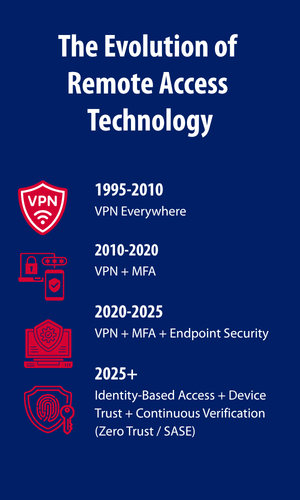
Modern attackers exploit stolen credentials, attack vulnerable edge devices, hijack unmanaged endpoints, and use third-party access paths. NIST's zero trust guidance explicitly advises against network access that is granted based only on network location or asset ownership, highlighting VPN shortcomings. In fact, CISA specifically includes VPNs among the most targeted edge devices. CISA goes on to warn that traditional remote access and VPN vulnerabilities create business risk, much like traditional firewalls, which were often set up and never revisited, creating security gaps over time.
What this all means is that VPNs aren't obsolete, but rather, using the tool for remote access is becoming so. With increasingly sophisticated and complex cyber attacks constantly bombarding networks, businesses need integrated access security that layers multifactor authentication, conditional access, endpoint protection, device health checks, least-privilege permissions, network segmentation, continuous monitoring, patch management, and clear technology and policy roadmaps toward a zero-trust security model for the organization.
Does that mean stop everything and replace your VPN?
No, but as the entire cybersecurity industry moves away from VPN architecture, you do need to work with your trusted business technology partner to craft a plan for moving toward that zero-trust security posture. Because VPNs are often a mishmash of solutions implemented over time or by device, migrating to a SASE solution is a great first step toward closing the gaps in your organization's network. Plus, it has the secondary bonus of improving the user experience, making it more likely to be used appropriately.
Key Benefits of SASE for Small Businesses Cybersecurity
We understand that replacing a key component in your business network, especially one that has seemingly worked well for a number of years, may be a difficult choice. But the benefits to your organization are clear. Plus, you gain the peace of mind knowing you have the right modern cybersecurity architecture in place to protect your business, data, employees, and customers.
While your business technology partner can guide you through implementing ZTNA, let's walk through the benefits of SASE and the role it plays in an improved security posture:
Enhanced Security
ZTNA, which is based on the principle of "never trust, always verify," ensures that only authenticated users and devices can access specific applications and features, significantly reducing the risk of unauthorized access and data breaches. SASE is imperative for this security stance. Because VPN only establishes trust at the login point, which is easily compromised, it isn't sufficient for ZTNA.
Simplified Remote Access
SASE replaces traditional VPN with a cloud-based solution that facilitates remote access security without the complexity and vulnerabilities associated with VPN setups.
Device-Centric Security
SASE ensures that security policies are applied based on user, device, and application context, offering more effective protection against complex threats.
Unified Management and Visibility
SASE offers simplified management of security solutions, eliminating alert fatigue for both organizations and their MSP. With VPN, gaps can often create confusing environments that modern endpoint security solutions cannot determine are secure, which means a constant need for manual review and approval. Centralized access to SASE provides improved visibility of user activity and potential threats, enabling IT teams to better respond to security incidents.
Support for Hybrid Workforces
As remote work continues its popularity, the need to secure disparate business resources also grows. SASE is purpose-built for the security challenges posed by hybrid workplaces while ensuring employees can effectively access the network tools they need, regardless of their location.
Jumpstarting Your Zero Trust Security Framework Journey with SASE Solutions
When it is time for your organization to eliminate VPN security risks by migrating to a more modern option that provides a more manageable, secure remote connection and a better user experience, let's talk about how we make that happen.
People Also Read:
Tech Essentials for Remote Success
Why Do SMBs Need Defense in Depth Cybersecurity?