
What Business-First AI Guidance Involves
Exigent Technologies is a managed IT services partner that helps small and midsize businesses identify where artificial intelligence can create real value — and where human judgment needs to stay in control. Rather than starting with an AI tool or platform, we start by looking at your business goals, data sensitivity, security requirements, and compliance obligations. Then we help determine where AI makes sense, where it doesn't, and what a practical starting point looks like.
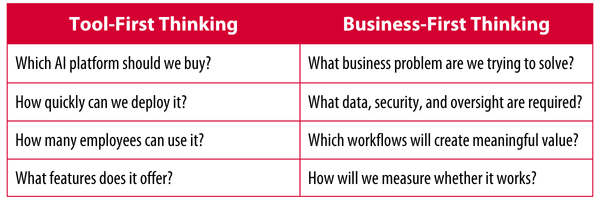
Why? Because artificial intelligence isn't a business strategy. Its value comes from applying it thoughtfully to the right work, with the right controls and clear responsibility for the outcome.
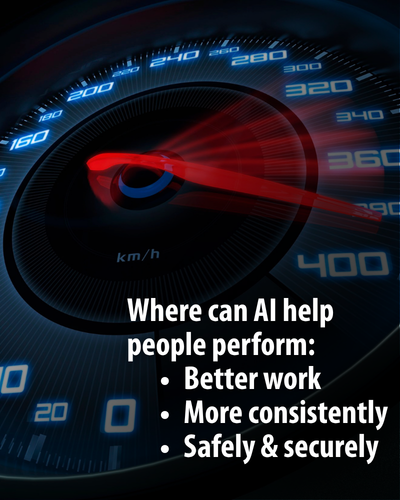
As your business technology partner, Exigent helps you take a practical, business-first approach to AI. We begin with the work your organization is trying to improve and ask: Where can AI help our people perform better, more consistently, and securely?
For some organizations, that may mean reducing repetitive administrative tasks or making information easier to find. For others, it could mean supporting faster analysis or simply giving employees a better starting point than a blank page.
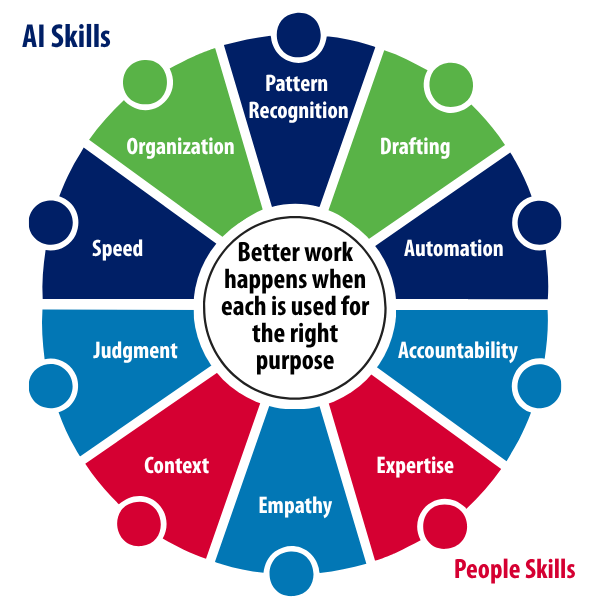
What it doesn't mean is removing people from decisions that require context, experience, creativity, accountability, or an understanding of your customers.
Many small and midsize businesses are interested in AI but aren't sure where to begin, which tools to trust, what information employees should — or shouldn't — share with those tools, or how to move forward without creating new security, compliance, or operational risks.
That's where a business-first approach matters.
Our role is to help you identify meaningful opportunities, evaluate risks, and make informed decisions about where artificial intelligence and automation belong within your technology roadmap.
How AI Adoption Works: Six Stages From Interest to Improvement





AI Use Cases Across Six Business Functions
There are many examples of use cases for artificial intelligence. Every one should be evaluated based on its business value, data sensitivity, accuracy requirements, compliance obligations, and need for human oversight.
Operations and Administration
Reduce manual data entry, summarize information, organize documents, draft routine communications, and support repeatable internal processes.
Customer Experience
Improve knowledge access, prepare response drafts, identify recurring questions, and help teams provide more consistent service.
Leadership and Decision Support
Summarize meetings, organize business information, identify patterns, and provide a stronger starting point for analysis and planning.
Sales and Marketing
Support research, content development, proposal preparation, customer relationship management records, and campaign analysis.
Finance and Human Resources
Extract information from documents, organize routine requests, identify exceptions, and prepare materials for human review.
Information Technology
Support documentation, ticket analysis, knowledge management, workflow automation, and the identification of recurring service trends.
When AI Should Not Make the Final Call
Artificial intelligence may analyze, summarize, draft, recommend, or automate. Your people remain responsible for reviewing the work, applying judgment, protecting sensitive information, and owning the outcome.
Some decisions should never be delegated solely to an automated system, particularly when they involve:
- Sensitive employee or customer information
- Legal, financial, healthcare, or regulatory consequences
- High-impact business decisions
- Customer relationships and reputation
- Security incidents or access decisions
- Situations requiring empathy, judgment, or accountability
AI Guardrails: Policy, Governance, and Shadow AI Risk
Your employees may already be using artificial intelligence at work, whether your organization has formally approved it or not. They may be using a public AI tool to summarize a document, draft an email, analyze information, take meeting notes, or help solve a problem.
This is often referred to as Shadow AI: the use of AI tools or applications for business purposes without the organization's knowledge, approval, or oversight. Often, employees are simply looking for a faster or better way to get their work done. The risk comes when they don't have clear guidance about which tools are safe to use or what company, employee, or customer information can be shared. That's why a clear AI policy matters.
A good AI policy shouldn't simply tell employees what they can't do. It should create practical guardrails that explain how to use artificial intelligence responsibly, what requires additional review, and where human judgment and accountability must remain part of the process. Whether your team is using one AI tool or dozens, a clear policy can prevent serious issues from developing.
Exigent helps clients work through questions such as:
- Which AI tools are approved for business use?
- What company, customer, employee, or confidential information should never be entered into an AI tool?
- How do AI vendors store, process, or use company data?
- Which AI-generated outputs require human review?
- Who remains accountable for a decision made with the assistance of AI?
- How should employees be trained to use AI safely and effectively?
- How will AI use be monitored and periodically evaluated?
- How does the organization's approach to AI align with its existing cybersecurity, privacy, and compliance requirements?
Learn more about AI Best Practices in our blog
These policies shouldn't be treated as a one-time exercise. AI tools, capabilities, and risks are changing quickly, and the way employees use them will evolve. Organizations need a process for evaluating new use cases and updating their guardrails as the technology evolves.
The goal isn't to keep your employees from using AI. It's to give them a safe, clearly defined way to use it well.
Security | Privacy | Governance | Human Review | Accountability

Why Exigent's AI Advice Comes From Practice, Not Theory
Exigent is learning how to best use artificial intelligence the same way we recommend our clients approach it. We started by exploring our business needs, applying appropriate controls, involving the people closest to the work, and improving over time.
Through our partnership with Shield Technology Partners, we also benefit from broader shared learning, resources, and practical experience across a larger community of technology professionals.
We bring those lessons into client conversations to help organizations:
- Identify realistic opportunities
- Avoid unnecessary or poorly matched tools
- Consider security and data risks early
- Connect artificial intelligence decisions to the technology roadmap
- Find the appropriate resources when deeper implementation expertise is needed
AI Guidance Through The Exigent Method
Artificial intelligence should not exist apart from the rest of your technology strategy. Our proven Exigent Method guides us through helping clients connect their IT decisions to operational priorities, security requirements, business goals, and long-term plans. AI becomes another area to evaluate within that ongoing consultative relationship—not a separate technology purchase driven by hype.
For Assurance Managed Services clients, that conversation may become part of strategic planning, technology roadmap development, and Periodic Business Reviews. From there, we assist with deploying the correct AI tools to support your organization's unique needs and ensure they align with security and compliance demands, regardless of your business type and industry.
Resources for Successful AI Adoption
Preparing Your Organization for AI
Practical steps for evaluating readiness, policies, data, workflows, and employee needs.
Where AI Delivers Business Value
Explore realistic examples of artificial intelligence and automation in small and midsize organizations.
Understanding Shadow AI Risk
Learn how unapproved tools may expose company information and complicate security and compliance.
Explore the Exigent AI Resource Kit
You Do Not Need an AI Product Pitch.
You Need a Place to Start.
Let's book an AI readiness consultation.
Whether your organization is actively exploring artificial intelligence or simply trying to understand how employees may already be using it, Exigent can help you begin with the right questions. Together, we can review your goals, discuss potential opportunities and risks, and determine the most practical next step for your organization. Fill out the form to schedule your free consultation.
FAQs
What does "Business-First AI" mean?
Does Exigent sell artificial intelligence software?
How can a small or midsize business prepare for AI?
Can Exigent help create an AI policy?
How do we know where AI will create value?
Is artificial intelligence secure?
Will AI replace our employees?
